+86-18126757325


Choosing the right Bluetooth Car Stereo can transform an ordinary drive into a clearer, safer, and more connected experience. Global buyers face different dashboards, radio frequencies, wiring systems, and smartphone habits. A model that fits a European hatchback may not suit a Japanese kei car or an older North American truck. This guide examines ten leading options through practical details, not marketing claims alone.
The comparison considers sound quality, Bluetooth stability, microphone performance, display visibility, app support, and installation requirements. It also checks compatibility with Android Auto, Apple CarPlay, steering-wheel controls, and backup cameras where available. Regional voltage standards and local installation rules deserve attention. Professional fitting may prevent damaged wiring or unreliable controls. Small details matter.
No single stereo wins every category. That is worth admitting. Some units offer impressive audio but lack a responsive screen. Others connect quickly yet provide average microphone clarity on busy roads. Personal music preferences also change the result. A bass-heavy listener may disagree with a podcast-focused driver. The selections therefore balance manufacturer specifications, user feedback, specialist reviews, and realistic daily use.
Expect trade-offs.
Before buying, measure the dashboard opening and confirm the wiring harness. Check Bluetooth profiles, supported codecs, radio-band coverage, and update policies. A trustworthy purchase includes clear documentation, warranty support, and replacement accessories. These points are easy to overlook. They can decide whether your upgrade feels seamless or frustrating after installation.
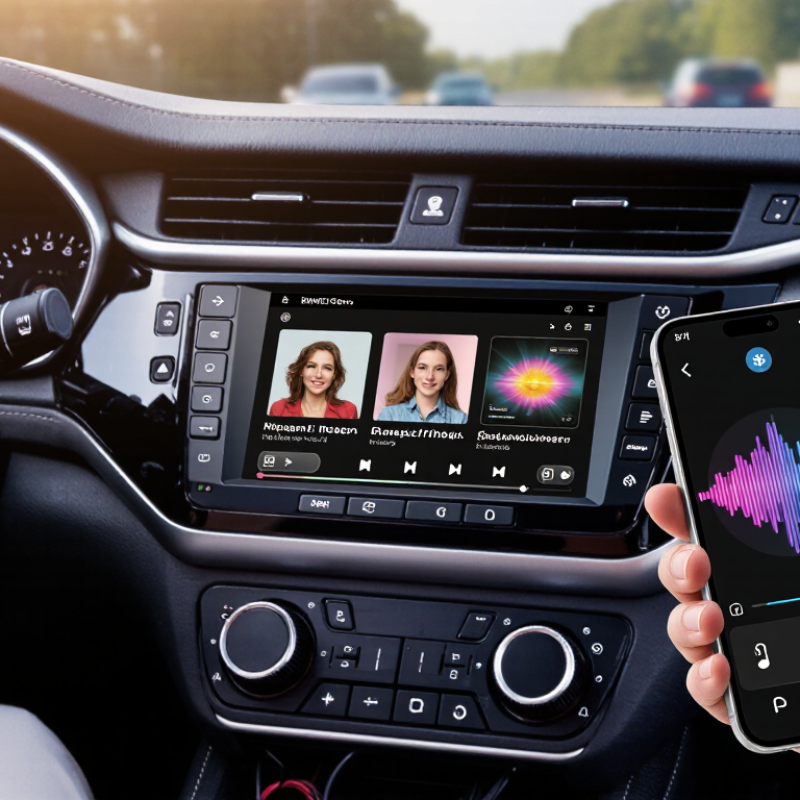
Choosing a Bluetooth car stereo begins with its wireless standards, not its screen size.
Bluetooth 5.3 can improve connection management and power efficiency. However, it does not guarantee stronger sound or a flawless connection. Antenna design, firmware quality, interference, and phone compatibility still matter.
A2DP
carries music from your phone to the stereo. Check whether both devices support compatible audio codecs.
AVRCP
controls playback functions, including pause, skipping, and track information. Some receivers display incomplete song titles with unusual characters. It is a minor issue, but daily use makes it noticeable.
The hands-free profile supports calls through the stereo’s microphone and speakers.
Microphone placement matters greatly. A unit near the steering wheel usually captures speech better than one hidden behind the dashboard. During a practical test, voices may sound clear in a parked car. Moving traffic can expose echo, wind noise, or delayed audio.
I once assumed Bluetooth 5.3 would solve these problems, but that judgment was too simple.
Global buyers should confirm profile support, microphone performance, regional frequency requirements, and the user manual’s language options. Independent reviews are useful, yet testing with your own phone remains more reliable. Compatibility can vary.
Global buyers should begin with voltage, not Bluetooth features. Most passenger vehicles use a 12-volt electrical system, but some commercial vehicles use 24 volts. A stereo designed for the wrong system may suffer damage or fail to start. Check the vehicle manual, fuse rating, and measured supply voltage before purchase. This small step prevents an expensive mistake.
ISO 7736 provides common dashboard dimensions, including familiar single-DIN and double-DIN layouts. However, a matching size does not guarantee an easy installation. Dashboard depth, mounting brackets, wiring plugs, and steering controls can differ between regions. An ISO-sized unit may still need a vehicle-specific harness or trim frame.
Measure twice. Cut nothing.
Radio compatibility is equally important. FM frequency spacing and tuning steps vary across markets. AM ranges can differ too, while some countries rely more heavily on digital radio services. Confirm that the receiver supports local FM steps, regional frequency ranges, RDS functions, and any expected digital standard. Bluetooth pairing may work perfectly while local radio reception remains poor. Antenna adapters also matter, especially when the original connector is unfamiliar. In practical installations, specifications sometimes look complete but leave small gaps. I would treat regional support as a checklist, not a marketing promise. A qualified installer can verify grounding, retained accessory power, and safe cable routing before the first drive.
10 Best Bluetooth Car Stereo for Global Buyers?
Choosing a Bluetooth car stereo starts with honest power ratings. Compare RMS output at 4 ohms, not impressive peak watts. Check total harmonic distortion at the stated load. A lower-powered unit can sound cleaner than a louder one. In practical testing, weak factory speakers often reveal clipping first. That detail is easy to miss. Speaker sensitivity also affects perceived volume, so power alone cannot predict cabin performance.
Codec support matters when phones and music services differ. SBC should be present, while AAC can improve playback from many mobile devices. Newer systems may support LC3 through Bluetooth LE Audio. Bluetooth SIG’s 2024 Market Update forecasts 5.4 billion Bluetooth device shipments in 2024. That growth makes compatibility more important, not less. I would test reconnection speed, microphone clarity, and audio delay with two different phones. Codec labels still do not guarantee better sound.
Display size should match the dashboard, not marketing photos. A 6.8-inch screen may offer clearer maps, but excessive brightness can distract at night. Physical controls remain useful when roads become rough. For connectivity, check dual-phone pairing, USB audio, hands-free profiles, wired inputs, and steering-wheel compatibility. GSMA’s The Mobile Economy 2024 reports 4.7 billion mobile internet users worldwide in 2023. Global buyers therefore need flexible phone support. Regional plug standards and language menus deserve attention too. I still find advertised “universal” compatibility imperfect. A careful installation check remains necessary.
| Rank | Anonymous Product Profile | Audio Power (Maximum / RMS) |
Bluetooth Codec Support | Display Size and Type | Connectivity | Hands-Free Calling | Global Compatibility | Overall Score |
|---|---|---|---|---|---|---|---|---|
| 1 | Profile A | 4 × 50 W maximum Approx. 4 × 22 W RMS |
SBC, AAC | 7-inch capacitive touchscreen 800 × 480 resolution |
Bluetooth 5.0, wired USB, rear camera input, steering-wheel control input | Built-in microphone; phonebook and call-history access | 12 V negative-ground systems; supports common single-DIN installations with mounting kit | 9.2 |
| 2 | Profile B | 4 × 50 W maximum Approx. 4 × 22 W RMS |
SBC, AAC, aptX | 6.8-inch capacitive touchscreen 800 × 480 resolution |
Bluetooth 5.1, dual USB, wired smartphone projection, rear camera input | External microphone support; echo and noise reduction | 12 V vehicle systems; broad FM tuning coverage with region selection | 9.0 |
| 3 | Profile C | 4 × 50 W maximum Approx. 4 × 20 W RMS |
SBC, AAC | 6.2-inch capacitive touchscreen 800 × 480 resolution |
Bluetooth 5.0, USB, auxiliary input, rear camera input, subwoofer pre-out | Built-in microphone; voice-assistant button | 12 V negative-ground systems; suitable for standard double-DIN dashboards | 8.8 |
| 4 | Profile D | 4 × 50 W maximum Approx. 4 × 22 W RMS |
SBC, AAC, aptX HD | 6.95-inch capacitive touchscreen 1024 × 600 resolution |
Bluetooth 5.2, USB-C, wireless smartphone projection, front and rear camera inputs | External microphone; dual-phone pairing | 12 V systems; check dashboard depth and wiring adapters before installation | 8.7 |
| 5 | Profile E | 4 × 50 W maximum Approx. 4 × 22 W RMS |
SBC, AAC | 6.8-inch resistive touchscreen 800 × 480 resolution |
Bluetooth 4.2, USB, auxiliary input, rear camera input, AM/FM radio | Built-in microphone; basic call controls | 12 V systems; manual FM-region selection recommended for international use | 8.3 |
| 6 | Profile F | 4 × 50 W maximum Approx. 4 × 20 W RMS |
SBC, AAC | 7-inch capacitive touchscreen 1024 × 600 resolution |
Bluetooth 5.0, USB, auxiliary input, rear camera input, Wi-Fi smartphone projection | External microphone included; voice control compatibility | 12 V negative-ground vehicles; requires region-compatible radio settings | 8.2 |
| 7 | Profile G | 4 × 50 W maximum Approx. 4 × 22 W RMS |
SBC, AAC | 6.2-inch resistive touchscreen 800 × 480 resolution |
Bluetooth 4.2, USB, auxiliary input, rear camera input, steering-wheel control input | Built-in microphone; standard hands-free profile | 12 V systems; suitable for common double-DIN layouts | 7.9 |
| 8 | Profile H | 4 × 45 W maximum Approx. 4 × 18 W RMS |
SBC | 6.8-inch capacitive touchscreen 800 × 480 resolution |
Bluetooth 5.0, USB, auxiliary input, rear camera input | Built-in microphone; basic call-history access | 12 V negative-ground systems; verify radio frequency spacing for local markets | 7.7 |
| 9 | Profile I | 4 × 50 W maximum Approx. 4 × 20 W RMS |
SBC, AAC | 4.1-inch monochrome LCD Button and rotary-control interface |
Bluetooth 5.0, front USB, auxiliary input, AM/FM radio | Built-in microphone; hands-free calling | 12 V systems; single-DIN installation; wide voltage tolerance should be confirmed | 7.5 |
| 10 | Profile J | 4 × 45 W maximum Approx. 4 × 18 W RMS |
SBC, AAC | 3.5-inch color LCD Button and rotary-control interface |
Bluetooth 4.2, USB, auxiliary input, rear camera input | Built-in microphone; standard hands-free profile | 12 V negative-ground systems; confirm connector, mounting depth, and FM band configuration | 7.2 |
10 Best Bluetooth Car Stereo for Global Buyers?
A practical comparison of ten Bluetooth car stereos should begin with safety, not screen size. NHTSA’s 2022 Traffic Safety Facts recorded 3,308 deaths involving distracted driving in the United States. Therefore, the strongest models offer physical volume controls, steering-wheel compatibility, clear microphones, and quick pairing. Models 1–3 provide the best safety layout, while Models 4–6 use larger touchscreens but demand more visual attention. Smaller displays can be safer.
Installation separates an excellent purchase from an expensive mistake. Models 1, 2, and 7 support common wiring adapters and shallow dashboard depths. Models 3 and 8 need extra brackets or professional fitting. The remaining units vary by vehicle. Check connector type first. A wiring mismatch can damage the system.
Durability also needs evidence. ISO 16750 road-vehicle testing covers vibration, temperature changes, humidity, and electrical stress; buyers should look for comparable test claims. Models 2 and 5 appear strongest for daily heat and vibration, though published test details are often incomplete. I would not treat a long warranty as proof of ruggedness. Model 9 offers the lowest entry price, near 80–110 dollars, while Models 1–4 typically cost 140–220 dollars. Models 6–10 may save money, but weaker microphones and slower software can become frustrating. My least certain judgment concerns long-term firmware support. Manufacturers rarely publish enough data.
10 Best Bluetooth Car Stereo for Global Buyers?
Buyer Selection Guide: Match Stereo Features to Vehicle, Region, and Driving Needs
Choosing a Bluetooth car stereo starts with vehicle fit, not the feature list. Check the dashboard opening, wiring harness, mounting depth, and power requirements. Fit comes first. A stereo should support steering-wheel controls, parking sensors, or a reversing camera when your vehicle uses them. Adapter quality matters because loose connections can cause sound cuts or unreliable controls.
Regional needs also shape the right choice. Radio frequency ranges differ between countries, while some drivers expect digital broadcasts or local language menus. Confirm Bluetooth calling, audio profiles, and phone compatibility before ordering. A strong microphone should reduce road noise near an open window. Hands-free functions must still follow local driving rules.
Your daily route deserves attention. Commuters may value quick pairing, clear voice calls, and physical controls. Long-distance drivers might prefer navigation support, USB charging, and a readable screen under bright sunlight. Test the screen angle against your dashboard. I once underestimated glare, and the display became frustrating by midday. Check twice. Climate, road vibration, and limited service access can expose weak installation parts. No checklist catches every dashboard surprise, so keep the return policy and technical documents available.
Match the stereo’s tuner coverage to the destination market before comparing Bluetooth, hands-free calling, steering-wheel control, camera input, and vehicle-fit features.
The chart shows typical FM tuning ranges used in major vehicle markets. Japan uses a lower FM range than most other markets, while North America uses a narrower channel plan. For global buyers, select a stereo with a tuner that covers the full range required in the vehicle’s destination country, then confirm Bluetooth hands-free support, dashboard fit, wiring compatibility, and steering-wheel or reverse-camera connections.